“دریا صرف تہذیب بناتے نہیں، مٹاتے بھی ہیں”
The Ravi River story began not with thunder—but with a song.
“Je aithon kadi Ravi lang jaave, hayati Punj-aabi ban jaave, main bairiyaan hazaar torr laan, main pani ichon saah nichorr laan…”
— Sajjad Ali, “Ravi vich Pani”
For decades, these lines had been a metaphor, a sigh for a river long gone. Lahore sang these Sajjad Ali’s words with nostalgia — “Je aithon kadi Ravi lang jaave…” — as if praying for a river that no longer existed. The Ravi, once the heartbeat of Punjab, had been reduced to a trickle of sewage and dust. Its banks were built over; its breath suffocated. Lahore—the city of gardens, poetry, and Mughal marble—had forgotten the sound of its own river. The Ravi, once the lifeline of Shah Jahan’s Lahore, where Anarkali’s tomb mirrored its reflection and where emperors built gardens like Shalimar to kiss its banks, had withered into a brown ditch. Then, in July 2025, after decades of silence, the Ravi finally came back its home.
When the River Returned
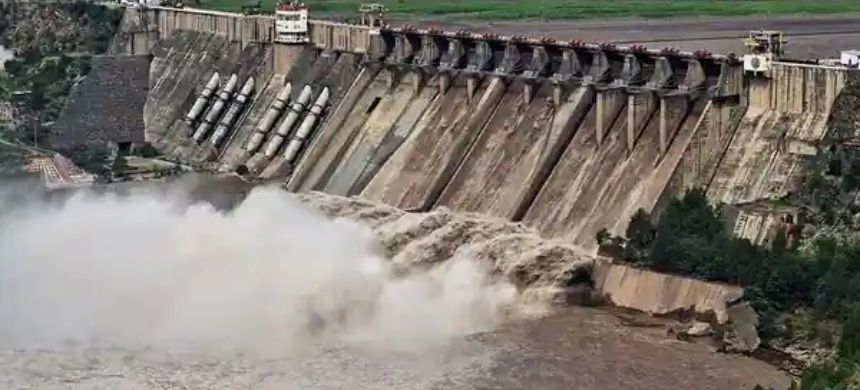
The monsoon arrived like an orchestra tuning up—drums of thunder, flutes of wind, cymbals of rain. Within 24 hours, the Pakistan Meteorological Department reported rainfall 80 percent above average. Upstream, India’s Madhopur Headworks opened its floodgates; downstream, Lahore braced itself.
At Shahdara Bridge, the Ravi’s discharge crossed 220,000 cusecs, the highest in forty years. Streets vanished, and entire neighborhoods—Park View Society, Talwar Park, Ferozewala—became islands. The Punjab Disaster Management Authority evacuated 150,000 people; nearly two million across the province were affected. Standing on the bridge that night, one man held up his phone playing Sajjad Ali’s song. “Main bairiyaan hazaar torr laan,” I will break a thousand barriers and breathe again through water, the voice echoed through the rain. And Ravi did. Very soon, Ravi actually came to meet its own Lahore.
“Ravi wich pani aa gaya,” whispered an old man on the bridge. “For the first time in my lifetime, the river looks like itself.”
A City and Its River
Lahore has always been a river’s child. The Mughals called it “the city of gardens beside the Ravi.” Emperor Jahangir’s tomb still lies close enough to hear the water when it flows, and Nur Jahan planted pomegranates that once drew sweetness from its soil. In 1637, Shah Jahan’s engineers designed the Shalimar Gardens so that canals diverted from the Ravi fountains would sing beside marble terraces.
But time was unkind. By the 20th century, industrial waste, encroachments, and diversions under the Indus Waters Treaty (1960) drained the Ravi of life. For decades, the city grew while the river shrank. Real-estate schemes replaced wetlands; the Ravi Urban Development Project turned the floodplain into a blueprint. When the 2025 monsoon arrived, the river didn’t invade—it reclaimed. It swept past bridges that once mocked its dryness, flooded boulevards named after progress, and reminded Lahore that civilizations built on water cannot outgrow it.
The case of Park View Society, situated perilously close to the Ravi’s ancient floodplain, symbolizes how luxury developments often ignore hydrological wisdom. Built on low-lying reclaimed land, its foundations rest barely above the old high-water mark. When the river surged in 2025, basements flooded within hours, cars floated in parking lots, and residents fled to rooftops awaiting rescue. The very advertisements that promised “Riverfront living” became a bitter irony. Experts later observed that this disaster was neither unforeseen nor unavoidable: urban planning maps from the 1980s clearly marked these zones as “flood-susceptible.” Yet land hunger and speculative development erased that caution.
When Nallah Lai Rose Again
In Rawalpindi, the infamous Nallah Lai reminded residents of its temper. Hydrologists recorded levels rising 17 feet within 45 minutes after a ten-hour downpour totaling nearly 600 mm — eerily close to the catastrophic storm of 2001 that killed 74 people. New housing projects had crept ever closer to its channel, and bridges narrowed its throat. The result was predictable: flash floods ripping through markets, vehicles tossed like toys, and emergency sirens howling through the night.
Karachi’s Awakening: The Rivers Remember
While Lahore rediscovered its river, Karachi relearned that its nallahs were Rivulets too. On July 18, 2025, a cloudburst dropped 110 mm of rain in under an hour—enough to drown a city built on concrete. The Lyari and Malir rivers, their beds narrowed by encroachments and expressways, exploded in fury. Water surged through Gulshan, Korangi, and Saadi Town, places built over their floodplain.
“Oh wow, Lyari Nadi was actually a nadi,” wrote one stunned resident on X (formerly Twitter)
The Malir, once a seasonal corridor twelve kilometres wide, had been reduced to a few hundred feet. During the 2020 storm that dumped 484 mm in August, experts warned that such events would happen again. In 2025, it did—bigger, faster, angrier. Karachi didn’t drown in rain; it drowned in its own forgetfulness.
The Miracle in Sindh
Far south, the Indus carried a gentler message. After two decades of drought, its water reached the Sindhi delta again. In Thatta and Badin, women wearing ajraks walked into the returning tide, releasing flower petals and earthen lamps onto the current. Fishermen in Keti Bunder wept.
“When the river comes, we welcome her like a guest who has forgotten the way home,” said one elder.
Between 1990 and 2020, freshwater reaching the sea had fallen by 80 percent; over 2.2 million acres of farmland turned saline, and mangroves shrank from 600,000 to 300,000 hectares. But in 2025, after relentless monsoon rain and upstream discharge, the Indus exhaled again. Where Lahore feared water, Sindh offered it flowers.
By the Numbers: 2025 Monsoon Rebellion
| Indicator | Figure |
|---|---|
| National rainfall average | 190% of normal |
| Ravi flow at Shahdara | 220,000 cusecs |
| Karachi rainfall peak | 110 mm per hour |
| People affected nationwide | ≈ 5 million |
| Economic loss | US $ 7.4 billion |
Yet the actual loss cannot be measured in rupees. It lies in the realization that Pakistan’s rivers—dismissed as relics—are alive, and waiting.
When Real Estate Met the River
The 2025 flooding of the River Ravi brought tragedy to Lahore’s doorstep, turning memory into catastrophe. Once celebrated as the “River of Love” and immortalized in Punjabi poetry, the Ravi now resembles a choked canal—its vitality drained by decades of siltation, encroachment, and the diversion of flow under the Indus Waters Treaty. Its bed, long transformed into a dry playground for real estate, suddenly roared back to life when, in July 2025, heavy monsoon rains combined with water releases from India’s Madhopur Headworks pushed the river’s discharge at Shahdara above 220,000 cusecs—the highest in decades. Within hours, the Ravi reclaimed its forgotten floodplain, submerging Park View Society, Shahdara, Talwar Park, Ferozewala, and adjoining settlements. More than 150,000 people were evacuated as floodwaters swelled, in what the Pakistan Meteorological Department called a “compound disaster”—a convergence of extreme rainfall, upstream releases, and blocked urban drainage.
Also Read: Breast Cancer Awareness Month: A Call to Action for Pakistan
Park View Society, built perilously close to the Ravi’s ancient floodplain, became the symbol of human defiance against hydrological truth. Its foundations, resting barely above the old high-water mark, gave way as the river surged; basements flooded within hours, cars floated in parking lots, and residents climbed to rooftops for rescue. The advertisements that once promised “riverfront living” became bitter irony. Experts later noted this tragedy was neither unforeseen nor unavoidable: urban planning maps from the 1980s had already marked these areas as “flood-susceptible,” but land hunger and speculative development erased that warning. The question, then, is not why the Ravi flooded, but why Pakistan’s floods keep worsening.
Climate change is only one part of the answer. Rising temperatures are amplifying the monsoon’s moisture-holding capacity, leading to heavier downpours, while unchecked urbanization has replaced absorption with asphalt. Wetlands, nullahs, and green belts—nature’s drainage infrastructure—have been buried under concrete. Lahore’s sprawl has expanded nearly sevenfold since the 1970s, with entire colonies built on the Ravi’s former floodplain. Meanwhile, the city’s drainage system remains designed for mild rainfall, not modern extremes. Encroachments, blocked culverts, and informal settlements choke the river’s flow, while political hesitation prevents enforcement. The upstream release policy of neighboring India during high-rainfall periods compounds the crisis, sending sudden surges that local infrastructure cannot absorb. The 2025 flood was not just a natural event—it was a reckoning, a reminder that rivers may forgive, but they never forget.
When the Rivers Spoke
Each river spoke differently. The rivers were not seeking revenge. They were remembering their paths. For decades, we built over them, fenced them, renamed them as drains. We stole their banks for housing, their flow for irrigation, their silence for waste. We thought they had died. But 2025 proved that rivers do not die; they wait. The Ravi came to Lahore to warn it, not to destroy it. Ravi spoke in thunder, telling us that Lahore’s heart once beat to its own rhythm. In an ironic tone, the Lyari Lyari said: evidence that a drain is still a river, albeit a more irate one. It stood tall in Karachi, reclaiming its previous splendor. The exhausted but merciful Indus made another journey to Sindh to shower its children with blessings.
Each river told the same story: Pakistan had forgotten its waters. Together they said, you built over us, you forgot us, but we remember you.
“We built cities as if the rivers were dead,” said one hydrologist. “They came back to prove otherwise.”
The Price of Forgetting
Pakistan’s rivers are victims of its own ambition. Wetlands have been filled for roads and housing; drainage networks are colonial relics meant for gentler rain. The Ravi Urban Development Project tried to “revive” the river with embankments and real-estate. Nature replied with irony: the 2025 flood submerged parts of that very corridor. In Karachi, the Malir Expressway constricted the floodplain, making drainage impossible. Each monsoon now becomes a referendum on planning failure.
When rivers rebel, it isn’t climate alone—it’s consequence.
Lessons in Water
If 2025 was rebellion, then 2026 must be repentance. Instead of fighting rivers, Pakistan must make room for them. The Netherlands learned this through its Room for the River program: move embankments back, restore wetlands, and let water breathe. Imagine the Ravi’s banks reborn as blue-green corridors—urban forests and walking trails that become spill zones during floods. Picture the Malir transformed into a parkland river, its wetlands filtering runoff instead of choking in trash. Technology can help: IoT water-gauges, radar rainfall sensors, SMS alerts—but technology without humility is useless. What’s needed most is respect: an understanding that rivers are not infrastructure, but inheritance.
When Water Became a Mirror
By late August, the storm quieted. The Ravi’s rage softened into silver ripples reflecting Lahore’s skyline. Children ran barefoot along the damp banks, collecting bottles of muddy water as proof that Ravi still lives.
A video went viral: “Very soon Ravi actually came to meet its own Lahore… oh wow.”
It wasn’t sarcasm anymore—it was awe. From the flower-strewn delta of Sindh to the drenched boulevards of Lahore, one truth shimmered in the receding tide: rivers never die. They wait—for rain, for memory, for mercy.
“Main bairiyaan hazaar torr laan, main pani ichon saah nichorr laan…”
I will break a thousand barriers and breathe through water again.
In 2025, Pakistan’s rivers did precisely that. They broke their barriers. They returned to the cities that had abandoned them and in their rebellion, they reminded us that civilization is not built against rivers—it is built beside them.