Shifa was academically strong, but she was shy. Speaking in front of others was difficult, and leadership did not come naturally to her.
Then she was given an opportunity to do something different: solve a real problem.
Through a school entrepreneurship programme, Shifa and an all-girl team developed Nebulavolt—an innovative concept responding to a familiar winter challenge in Sindh: dense fog and poor visibility on roads.
Their idea combines an absorbent mesh to capture water droplets from fog with nanogenerators designed to harvest energy associated with those droplets and convert it into electricity, with potential applications such as lighting.
But Nebulavolt became about much more than technology.
It became a lesson in what happens when girls are given the space to experiment, lead, fail, improve and be heard.
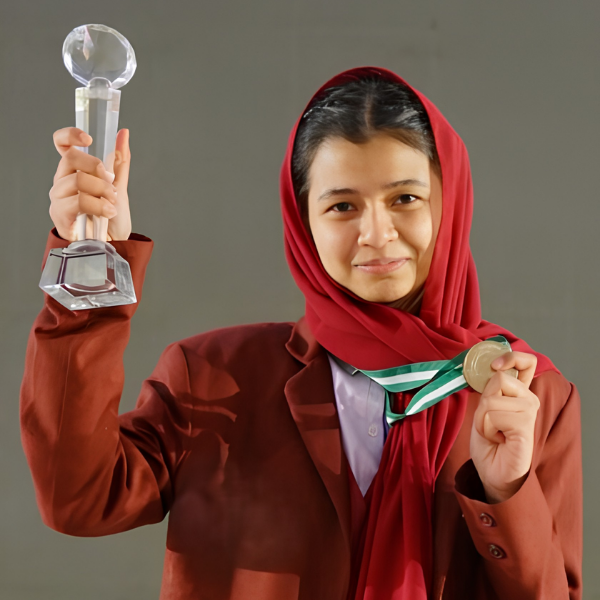
Shifa led her team through the regional and national rounds of Enterprise Challenge Pakistan 2026, ultimately winning the national competition.
Yet the most significant victory may not have been the trophy.
It was Shifa herself.
The girl who once struggled to speak publicly learned to stand before an audience and confidently explain and defend an idea of her own. Along the way, she strengthened her:
Critical thinking
Problem-solving
Communication and presentation
Teamwork
Entrepreneurship
Leadership
Self-confidence
Today, Shifa says she wants to become a green entrepreneur and develop sustainable solutions for Pakistan.
From Education to Agency
Girls’ empowerment is often measured by whether a girl goes to school. But education becomes truly transformative when girls are trusted to create, lead and solve problems.
Shifa’s story challenges the familiar assumption that science, technology, entrepreneurship and innovation are primarily spaces for boys.
She is 17—and already working with an all-girl team to imagine a technological response to a problem affecting everyday life.
Her story asks a bigger question:
What if Girls are not Simply Beneficiaries of Solutions—But The People Designing Them?
Shifa did not merely find her voice.
She discovered that her ideas could matter.
And perhaps that is the most powerful outcome of all: a girl who once hesitated to stand on a stage now stands there not as a passive learner, but as an inventor, leader and problem-solver—showing other girls that their ideas deserve space in the future of Pakistan.