
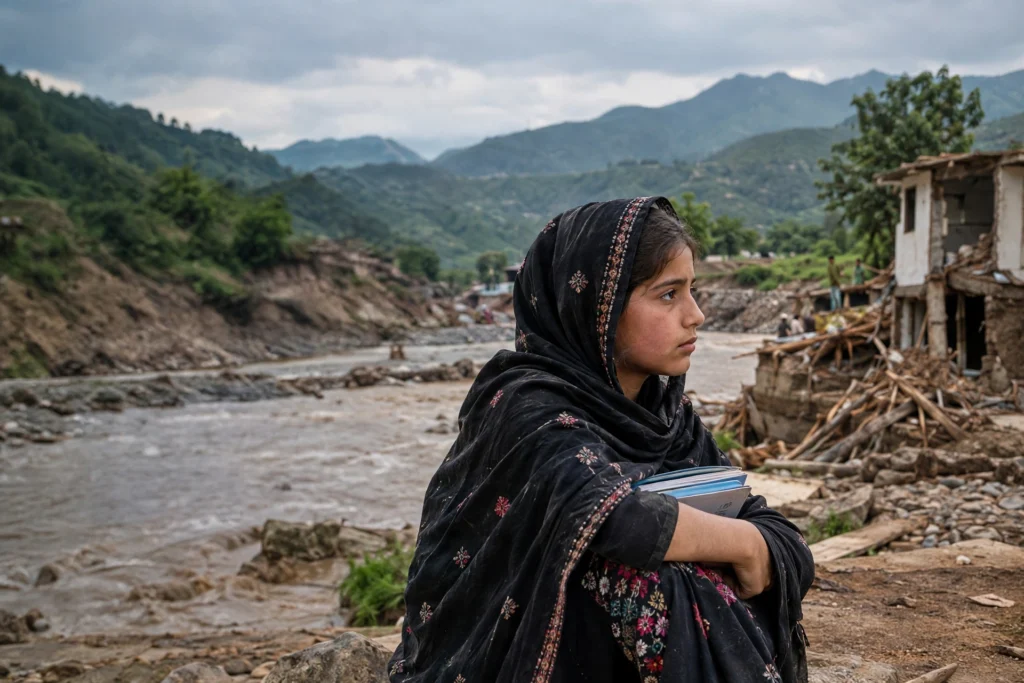
The floodwaters have receded, but the disaster has not ended for families struggling to rebuild their lives. When devastating flash floods struck Khyber Pakhtunkhwa in August 2025, they swept away homes, damaged farmland, destroyed businesses and disrupted education. Yet beyond the visible destruction lies a less documented crisis: the growing vulnerability of adolescent girls whose education and future choices may be threatened by economic hardship.
A destroyed house can be rebuilt. A damaged road can be repaired. But when a girl leaves school because her family can no longer afford her education, the consequences may be permanent.
For households already surviving on limited agricultural income, livestock or daily wages, the loss of livelihoods can turn ordinary expenses into impossible choices. School transport, uniforms and books must compete with food, shelter and debt repayment. Under such pressure, girls may face increased domestic responsibilities, interrupted schooling and, in vulnerable households, pressure to marry early.
According to UNICEF’s September 12, 2025, situation update, approximately 1.57 million people were affected in Khyber Pakhtunkhwa, with 504 deaths reported in the province. Across Pakistan, 946 people had died, including 255 children. These figures reveal the immediate human cost. They cannot show how many girls subsequently lost their education, faced marriage pressure or entered hazardous work.
In Buner, Swat and Shangla, the loss of agricultural assets, livestock and small businesses placed further strain on vulnerable households. When families struggle to afford food, shelter and debt repayment, education-related expenses become difficult to sustain. In such circumstances, girls may face pressure to leave school, undertake unpaid domestic work or enter arrangements that expose them to exploitation. Even where public schooling is free, transport, stationery, uniforms and safe access remain significant concerns.
Behind the devastating flood statistics are the unheard struggles of adolescent girls whose futures remain uncertain.
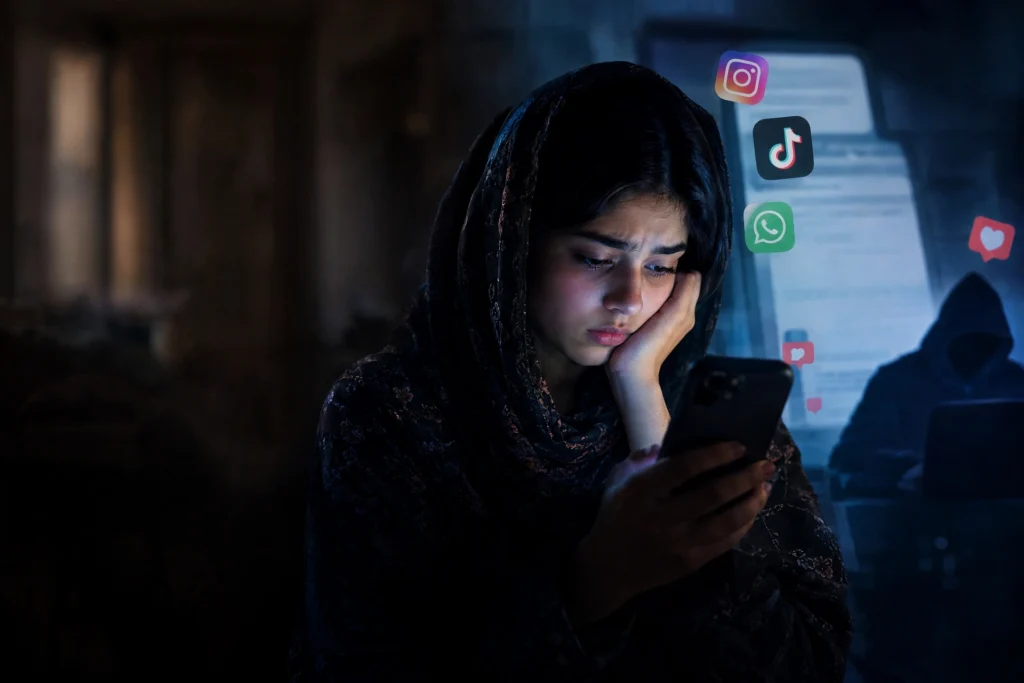
Two confidential accounts from girls facing severe economic hardship highlight the difficult choices confronting vulnerable families in flood-affected communities of Khyber Pakhtunkhwa. With livelihoods destroyed and household incomes disappearing, some parents may feel compelled to send their daughters into labour or arrange early marriages as a means of economic survival. For these girls, such decisions threaten not only their education but also their childhood, dignity and personal safety. Exploitative labour can expose them to abuse, isolation and dangerous working conditions, while child marriage may force them into adult responsibilities and early motherhood before they are physically or emotionally prepared. Adolescent pregnancy carries serious health risks, including life-threatening complications during pregnancy and childbirth, particularly where access to maternal healthcare is limited.
These circumstances reveal a disturbing reality: when families are left without adequate financial assistance or social protection, girls may bear a disproportionate burden of economic desperation. Their experiences underscore the urgent need for livelihood support, continued education and effective child protection systems to ensure that no girl is forced to sacrifice her future for her family’s survival.
The connection between poverty and child marriage is well documented.
Pakistan’s National Commission on the Rights of Child, in its State of Children in Pakistan 2024 report, identifies poverty, limited educational opportunities and social pressures among the factors associated with early marriage. However, poverty does not automatically lead families to marry their daughters. The concern is that disasters can intensify existing vulnerabilities when economic assistance and child protection services fail to reach those most in need.
Child marriage was already a serious concern in Khyber Pakhtunkhwa before the floods. UNICEF, citing the province’s 2019 Multiple Indicator Cluster Survey in June 2026, reported that 22 percent of girls were married before turning 18. The National Commission on the Rights of Child’s 2024 report, using a different survey indicator, found that 26.3 percent of women aged 20–24 had married before adulthood. These figures cannot be directly compared, but both demonstrate the scale of an existing problem.
No verified district-level data in the reviewed sources establishes how many girls were married specifically because of the 2025 floods.
While the impact on child marriage remains insufficiently measured, the destruction of educational infrastructure is documented. In August 2025, Dawn, citing district education officials, reported that 128 government schools in Swat had become partially or completely unusable. Damaged roofs collapsed boundary walls and flooded classrooms disrupted access to learning.
The extent of the problem became clearer in January 2026, when UNESCO published an assessment of 120 government girls’ primary schools in Bahrain, Charbagh, Khwazakhela and Matta. It found that 46 percent had damaged or leaking roofs, 31 percent had damaged boundary walls and 35 percent lacked fully functional sanitation facilities. Most alarmingly, 93 percent lacked functional psychosocial support or child protection referral mechanisms. UNESCO’s recovery initiative aimed to improve learning conditions for more than 12,000 girls.
These findings expose a dangerous gap between reopening schools and restoring education. A school without safe toilets, secure boundaries or adequate protection services may remain inaccessible to vulnerable girls even after classes resume. For families already struggling financially, damaged infrastructure can become another reason to delay a daughter’s return. Yet the number of girls who permanently dropped out following the floods remains undocumented in the cited assessments.
Reconstruction efforts have begun. In February 2026, UN-Habitat announced a Japanese-supported school rehabilitation program worth approximately US$2.7 million, particularly targeting Swat and Buner. The agency reported that 437 schools across KP had been damaged by the floods. While such investment is essential, rebuilding classrooms alone cannot guarantee that girls will return. Economic assistance, safe transport, sanitation and protection services are equally important.
A documented example from Mardan demonstrates that child marriage can be prevented through community intervention. In June 2026, UNICEF highlighted the work of Shaheen Begum, a Lady Health Visitor and community child protection activist in Khazana Dheri village. Through a Community-Based Child Protection Committee, she and her colleagues successfully prevented four planned child marriages, helping the girls remain in school. Her work also challenged swara, the practice of giving girls in marriage to settle disputes.
Shaheen’s interventions were not linked to the 2025 floods, but they offer an important lesson: community protection mechanisms can work when trained local women, families and institutions cooperate. UNICEF reported that 87 such committees had been established across Chitral, Mardan, Swat, Charsadda and Lower Dir. However, the available reporting does not establish how many operated in flood-affected settlements or how many vulnerable girls they supported after the disaster.
This is where the accountability gap becomes impossible to ignore. UNICEF documented child protection and psychosocial support activities during the flood response, yet publicly available information reviewed for this article does not provide a complete district-level picture of girls who received assistance, returned to education or were protected from early marriage. Without such evidence, the effectiveness of recovery program cannot be fully assessed.
The problem is not simply a shortage of statistics. It is what those missing statistics represent. If authorities can count damaged schools but cannot determine how many girls returned, recovery remains incomplete. If protection committees exist but their reach into displaced communities is unclear, vulnerable children may remain beyond the support system.
Climate disasters do not create gender inequality, poverty or child marriage. They expose and can intensify them.
The responsibility of government, humanitarian organizations and local institutions is therefore not limited to restoring infrastructure. Recovery must include household livelihood support, educational reintegration, functional child protection referrals and meaningful participation by girls in decisions affecting their lives.
More than a year after the floods, Khyber Pakhtunkhwa faces a test that cannot be measured in rebuilt roads or repaired buildings alone. The real measure of recovery is whether children, especially vulnerable girls, can reclaim the opportunities that disaster placed at risk.
The floods were a natural disaster. Allowing preventable educational exclusion and protection failures to persist would be a failure of recovery.
A girl should not have to abandon her education because her family lost its livelihood. She should not have to surrender her childhood because support failed to arrive. And she should not disappear from public concern simply because the floodwaters have receded. The true cost of a disaster is not only what it destroys, but what society fails to protect afterward. No girl’s future should become the price of her family’s survival.
Editorial Note: The identities of the two interviewed girls have been withheld to protect their privacy and safety. Facts and statistics are sourced from UNICEF, UNESCO, WHO, UN-Habitat, NCRC and credible news reports available.

What Pakistan Can Learn from Poland’s Energy Transition