
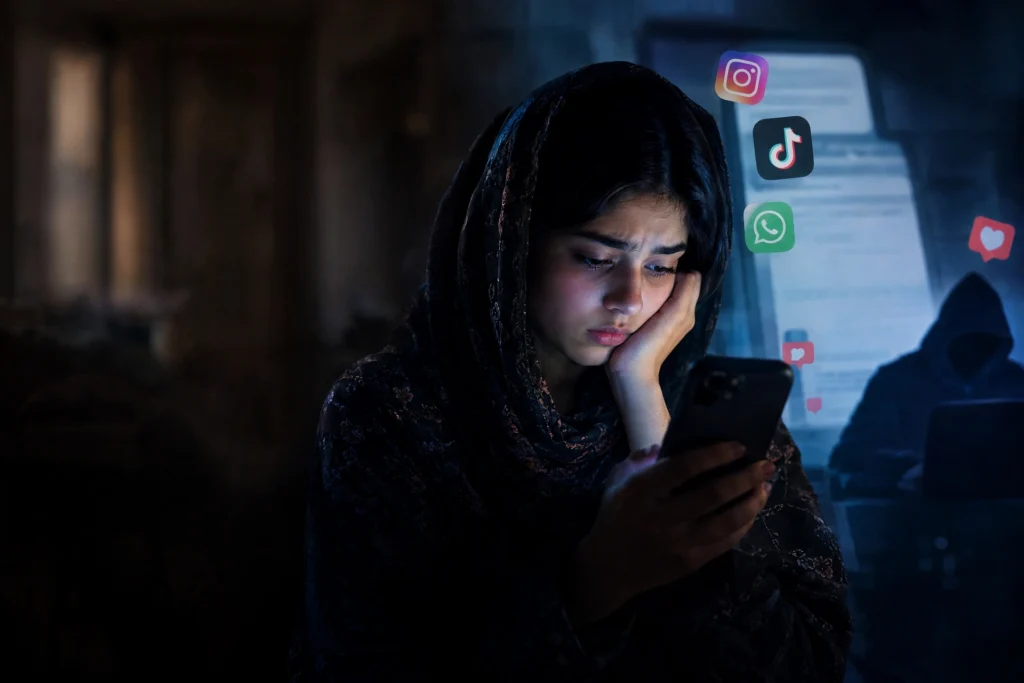
A teenage girl receives inappropriate and disturbing messages on her phone. Another discovers that her private photographs have been circulated without consent. A woman journalist faces repeated threats and character assassination on social media. A university student is blackmailed through a fake account, afraid that reporting the harassment could expose her to further humiliation.
Different victims. Different platforms. The same growing crisis: digital harassment and technology-facilitated violence against women and girls.
The internet has opened doors to education, employment, communication and freedom of expression. Yet for many women and girls in Pakistan, these opportunities come with increasing risks. Social media, smartphones and artificial intelligence are being misused to threaten, manipulate, exploit and silence individuals. The question is no longer whether digital violence exists. It is why so many victims remain unprotected while society continues to scroll past their suffering.
Pakistan’s Digital Harassment Crisis: What the Numbers Reveal
The scale of reported digital harassment in Pakistan demands urgent attention. According to the Digital Rights Foundation’s (DRF) Digital Security Helpline Annual Report 2025, released in April 2026, the organisation received 3,012 new complaints during 2025, including 2,586 cases of cyber harassment—approximately 250 new complaints every month. Women accounted for 1,709 complaints, compared with 1,279 reported by men. Young adults aged 18–30 represented 51.3% of all complaints, demonstrating the significant exposure of digitally active young people. The report also documented 94 cases involving journalists and media practitioners and 52 involving human rights defenders. Geographical disparities were striking. Punjab accounted for 69.5% of Pakistan-based complaints, while Balochistan represented only 3%, Azad Kashmir 0.6% and Gilgit-Baltistan 0.26%. These differences do not necessarily indicate lower levels of harassment in underserved regions. They may reflect unequal access to digital literacy, reporting mechanisms and support services. Since its establishment in 2016, DRF’s helpline has recorded 23,032 cases. These are documented helpline complaints, not a national prevalence estimate. Nevertheless, they reveal the substantial demand for digital protection and assistance.
Children and Girls Facing an Invisible Emergency
One of the most alarming findings of 2026 concerns children’s online safety. In September 2026, UNICEF, ECPAT International and INTERPOL released Disrupting Harm in Pakistan, reporting that nearly one in 16 internet-using children aged 12–17 experienced technology-facilitated sexual exploitation or abuse within a single year—approximately 1.5 million children nationwide.
The findings challenge common assumptions about online predators. In 85% of incidents reported by children, the perpetrator was someone they already knew. Social media accounted for 44% of reported instances of abuse. More than half of affected children did not disclose their experiences to anyone, while none of the children surveyed reported their experiences through formal channels such as police, social workers or helplines.
Girls and boys experienced abuse at similar rates, although the forms of harm and barriers to disclosure could differ. Against this backdrop, Pakistan’s findings form part of a wider international emergency. UNICEF’s September 2026 global report, Through Children’s Eyes, estimated that 20 million internet-using children across 21 countries experienced technology-facilitated sexual exploitation or abuse in a single year.
The Digital Rights Foundation’s own findings reinforce these concerns. Complaints involving minors increased by 28%, from 124 in 2024 to 159 in 2025. For children facing digital blackmail or harassment, fear of blame, social stigma and family restrictions can become powerful barriers to seeking help. When children are afraid to report abuse, silence protects perpetrators rather than victims.
When Social Media Becomes a Tool of Intimidation
Digital violence extends far beyond offensive messages. Cyberstalking, impersonation, account hacking, blackmail, non-consensual image sharing and coordinated harassment can cause serious emotional distress and damage educational, professional and social opportunities.
DRF’s May 2026 report, Digital Threats Against At-Risk Communities in Pakistan, analysed 5,041 new cases handled between May 2024 and December 2025. It identified hacking, image-based abuse, blackmail and coordinated harassment as significant threats, particularly affecting women, transgender women and individuals in public-facing roles.
The organisation’s 2025 helpline report also found that WhatsApp, Facebook and Instagram collectively accounted for 53% of reported cases, with WhatsApp alone accounting for 34%. For women journalists and human rights defenders, coordinated digital attacks can discourage reporting, advocacy and participation in public debate.
Online harassment is therefore not simply an individual safety concern. It can undermine freedom of expression and women’s participation in public life. A woman’s digital voice should never come at the cost of her dignity or safety.
Also Read: After the Floods: How Economic Survival Is Putting Girls’ Futures at Risk in Khyber Pakhtunkhwa
Pakistan’s Justice Gap: Thousands of Complaints, Limited Accountability
Pakistan’s growing digital participation has not been matched by equally effective protection. According to figures published by the United Nations Development Programme in March 2026, approximately 135,000 cybercrime complaints were recorded in Pakistan during 2024, but only 826 cases proceeded to prosecution—roughly 0.6%. These figures cover cybercrime generally, not exclusively gender-based digital violence. Nevertheless, they expose a substantial gap between complaints and cases reaching prosecution.
DRF’s 2025 helpline report revealed another serious obstacle: only 51% of cyber harassment complaints came from cities with operational cybercrime offices. The organisation received 892 complaints from cities without such offices. Survivors in underserved areas may face lengthy travel, financial costs and procedural difficulties simply to pursue justice.
Pakistan’s Prevention of Electronic Crimes Act provides legal provisions addressing cyberstalking and certain forms of image-based abuse, while the National Cyber Crime Investigation Agency is responsible for investigating cybercrime offences. Yet effective protection requires trained investigators, confidential reporting mechanisms, digital evidence preservation, legal assistance and timely institutional responses. Justice cannot end with registering a complaint. It must deliver meaningful protection and accountability.
Artificial Intelligence: A New Threat to Digital Safety
Artificial intelligence has introduced another disturbing dimension to online harassment. AI tools can be misused to manipulate photographs, create fabricated intimate images, impersonate individuals and circulate misleading material intended to humiliate or intimidate victims. Even entirely fabricated images can cause reputational harm, psychological distress and fear of social exclusion.
DRF’s May 2026 research identified AI-generated deepfakes among the emerging threats affecting vulnerable communities in Pakistan. Technology companies must strengthen safeguards against misuse, improve reporting mechanisms and respond rapidly to complaints involving manipulated and non-consensual imagery. Technological innovation cannot be called progress when protection fails to keep pace with its potential for harm.
From National Strategy to Real Protection
In March 2026, Pakistan’s Ministry of Human Rights, in collaboration with UNDP, launched the country’s first National Strategy to Counter Technology-Facilitated Gender-Based Violence.
This strategy represents an important policy commitment, but its success will depend on practical implementation. Schools and universities must strengthen digital literacy, privacy education and confidential reporting systems. Parents and teachers should ensure that girls can report harassment without fear of blame or punishment. Boys and young men must be engaged in promoting consent, respectful digital behaviour and accountability.
Government institutions should improve access to cybercrime reporting, strengthen investigations and publish measurable information about complaints, prosecutions and survivor support. Technology platforms must provide accessible reporting mechanisms and respond promptly to harmful content. Community-based digital literacy centres and safe spaces can help women and girls understand their rights and access legal, technical and psychological assistance. The burden of preventing digital violence must not fall solely on those experiencing it.
The Violence We Scroll Past Must No Longer Be Ignored
A girl afraid to open her messages, a student silenced by blackmail and a journalist intimidated into withdrawing from public debate represent more than isolated incidents. They expose a digital environment in which opportunities are expanding faster than protections.
Pakistan cannot celebrate digital empowerment while women and girls remain vulnerable to harassment, exploitation and intimidation. The true measure of digital progress is not how many women and girls gain access to technology, but whether they can use it freely, safely and with dignity.
Every threatening message matters. Every violated boundary matters. Every survivor deserves protection. Because violence does not become less harmful when it happens behind a screen. And the violence we continue to scroll past is the violence we risk allowing to continue.

What Pakistan Can Learn from Poland’s Energy Transition