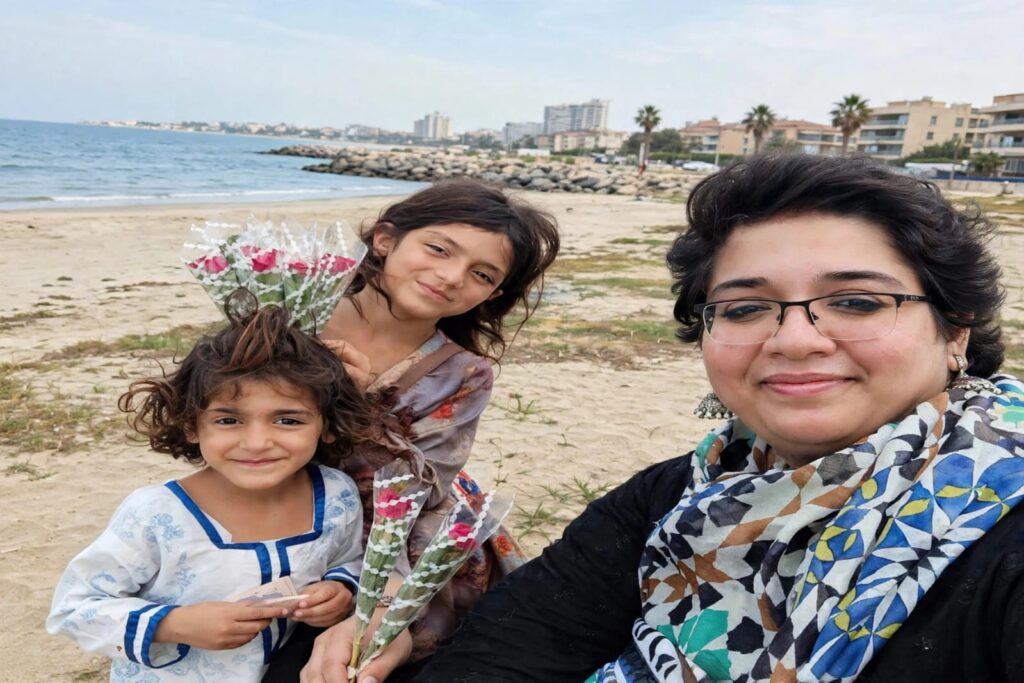
Two years had passed since I last visited Karachi. Returning after my cancer treatment was an emotional journey in itself. I had survived a battle that had changed my understanding of life, suffering and resilience. I arrived carrying memories of pain, recovery and the quiet determination to begin again. I went to the beach, hoping to find a little peace, perhaps a moment to reconnect with myself after years of uncertainty.
Instead, I encountered two beautiful young souls who made me look beyond my own struggles.
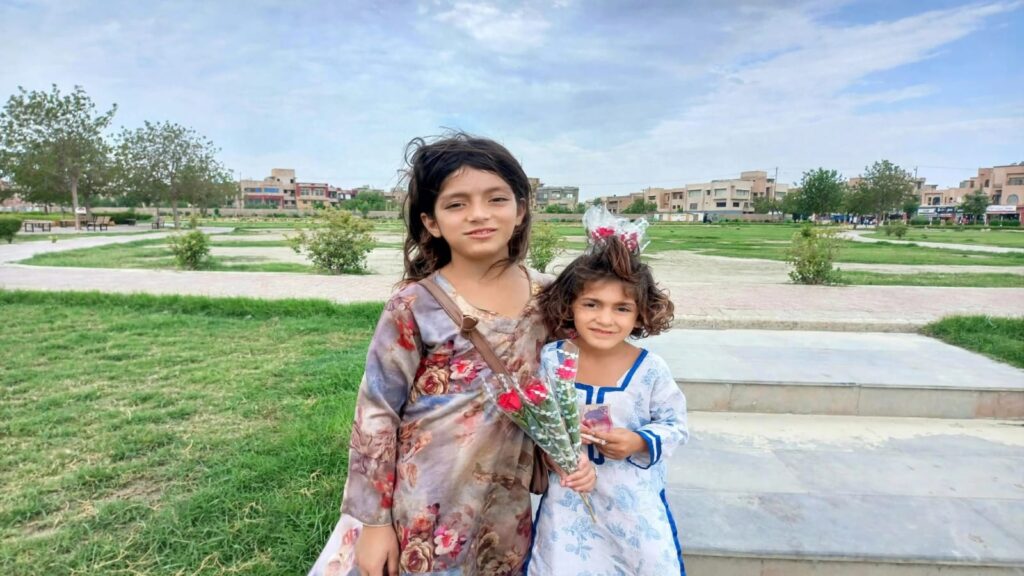
They were selling flowers.
Their small hands held roses, and their young faces carried the innocence that should belong to every childhood. One of them, Zainab, looked at me with remarkable curiosity. She stared for a moment, then smiled and said, “Sister, you are beautiful.”
Her simple compliment caught me off guard. It was an unexpectedly beautiful moment. We began talking, and soon I learned that the girls were helping their families earn money. While children their age should have been learning, playing and discovering the world, these girls were spending their time selling flowers to help put food on the family table.
Their words stayed with me long after our conversation ended.
I had travelled to the beach hoping to find peace after years of illness. Instead, I found myself confronting another kind of suffering: the quiet loss of childhood to poverty. I could not stop thinking about how easily a child’s dreams can be overshadowed by the urgent need to earn a living.
Zainab’s compliment was innocent, her smile genuine, but the circumstances surrounding her childhood raised difficult questions. How many children in Pakistan are growing up with responsibilities that should never be theirs? How many are missing school because their families cannot afford to let them remain children? And how many carry emotional burdens that the adults around them barely recognize?
I did not meet two statistics that day. I met two children whose circumstances brought the country’s education and child protection challenges into sharp focus.
When Poverty Takes Children Out of School
Zainab and Fatima’s story reflects a wider challenge confronting Pakistan, where poverty, educational exclusion and child labor continue to deprive millions of children of opportunities to learn and develop. The latest available household survey data for 2024–25, published by the Pakistan Bureau of Statistics, show that 28 per cent of children aged 5–16 are out of school, including 31 per cent of girls and 25 per cent of boys. This represents a substantial improvement from the 38 per cent reported in 2023, but the gender gap remains significant. Regional disparities are even more pronounced: 45 per cent of school-age children in Balochistan, 39 per cent in Sindh, 28 per cent in Khyber Pakhtunkhwa and 21 per cent in Punjab are out of school. In Balochistan, 52 per cent of girls are excluded from education, compared with 38 per cent of boys. These figures reveal that educational exclusion is not evenly distributed; it is shaped by poverty, gender, geography and unequal access to educational infrastructure.
Behind these statistics are children whose families’ economic circumstances shape their educational opportunities. For households dependent on daily wages, sending a child to school can involve difficult financial choices, even when tuition is free. Uniforms, books, transportation and other expenses can become insurmountable barriers. When families struggle to afford food, shelter and healthcare, children’s immediate contribution to household survival may take precedence over their long-term educational prospects. Girls face additional obstacles, including domestic responsibilities, safety concerns and social expectations that restrict their mobility. Children with disabilities, those living in remote communities and those displaced by natural disasters encounter further barriers to accessing education. The problem extends beyond school enrolment: prolonged exclusion can deprive children of literacy, confidence, social development and the skills needed to escape intergenerational poverty.
Also Read: Kaneez Fatima’s Fight for Women’s Health and Cervical Cancer Awareness in Gilgit-Baltistan
Child Labor: When Survival Replaces Childhood
Pakistan’s child labor crisis further exposes the relationship between poverty, educational exclusion and the loss of childhood. A national synthesis of provincial and Islamabad Capital Territory child labor surveys, released by UNICEF in 2026, estimates that 8.6 million children aged 5–17 are engaged in child labor, including 6.6 million in hazardous work. Based on nearly 200,000 households and more than 500,000 children, the surveys provide a comprehensive national evidence base on the scale, causes and consequences of child labor. The findings highlight the risks children face in different working environments and the connections between labor, education, health and psychological well-being.
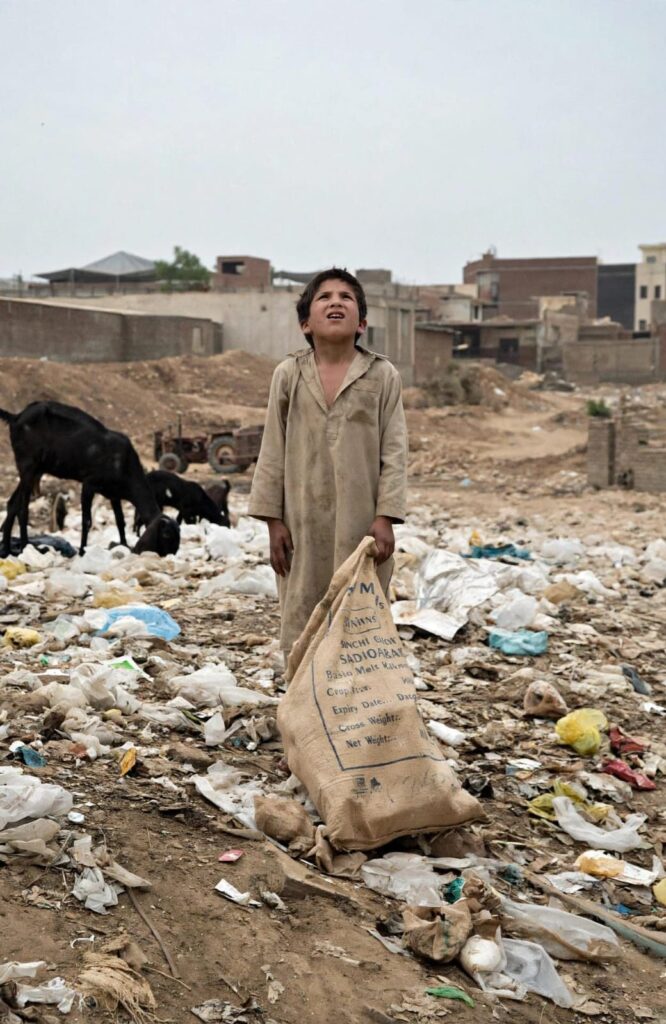
Children across Pakistan work in agriculture, brick kilns, workshops, domestic service, markets, waste handling and recycling industries and on the streets, often in environments that expose them to physical exhaustion, hazardous machinery, dangerous chemicals and exploitation. The two girls selling flowers on Karachi’s beach brought the human dimension of these statistics into focus. Their small flowers represented more than a means of earning money; they prompted difficult questions about the economic pressures that lead children to work, and the opportunities denied to those who must contribute to their families’ survival. Street-based work can expose children to traffic accidents, harassment and exploitation, while limiting their opportunities for education, recreation and social development. Although Zainab and Fatima’s individual circumstances require further verification, their encounter highlights the importance of understanding the realities of children working in public spaces.
Child labor is not simply an economic activity involving children; hazardous and exploitative work is a serious child protection concern. Addressing it requires more than removing children from workplaces. Families need social protection, sustainable livelihoods, accessible education and decent employment opportunities for adults. Without addressing the economic pressures that compel families to depend on children’s earnings, efforts to eliminate child labor risk treating its symptoms while leaving its underlying causes unresolved.
Climate Displacement: When Disasters Steal the Classroom
Climate-related disasters add another dimension to Pakistan’s education and child protection crisis. Floods, extreme heat and other environmental hazards can destroy homes, disrupt livelihoods and force families to leave their communities. The 2022 floods affected approximately 33 million people, including 16 million children, and damaged or destroyed nearly 27,000 schools. In November 2022, more than two million children were unable to access their schools. These figures demonstrate how a climate emergency can rapidly become an educational and humanitarian crisis, particularly for children already living in poverty. The effects continued during subsequent monsoon seasons. According to UNICEF’s 2025 humanitarian reporting, floods across Pakistan damaged 1,836 schools during the 2025 monsoon season, including 884 in Punjab and 695 in Khyber Pakhtunkhwa. Nearly 48 per cent of the damaged schools were girls’ schools. These figures illustrate the continuing vulnerability of educational infrastructure to climate-related disasters. In 2025, UNICEF also reported that the floods and flash floods had caused substantial loss of life, including among children, and created urgent needs for protection, education and psychosocial support.
Climate displacement can push already vulnerable households deeper into poverty. When families lose homes, agricultural livelihoods, and essential possessions, children may be expected to earn money, do additional domestic work, or care for younger siblings. Although displacement does not automatically lead to child labor, the combination of school closures, financial hardship and prolonged displacement can increase children’s exposure to exploitation and educational exclusion. The consequences extend beyond the immediate loss of classroom instruction: children may lose friendships, familiar surroundings and the sense of security essential to their development. Extreme heat and recurring floods also threaten continuity of learning, making climate-resilient schools, temporary learning centers and accessible educational services essential to protecting children’s futures.
The scale of the global challenge reinforces the urgency of action. UNICEF’s January 2025 analysis found that 242 million students across 85 countries experienced climate-related school disruptions in 2024, including 128 million in South Asia. These findings underline how climate hazards can interrupt education on a massive scale, particularly in regions where educational infrastructure and household resources are already limited.
Mental Health: The Invisible Cost of a Childhood Spent Surviving
Behind the statistics on school exclusion, child labor and climate displacement lies another critical concern: children’s mental health. Children compelled to work may experience exhaustion, anxiety, social isolation and uncertainty about their future. Those who leave school can feel excluded from the opportunities available to their peers, while displaced children may struggle with the loss of their homes, friendships and familiar surroundings. The World Health Organization estimates that one in seven adolescents’ aged 10–19 worldwide experiences a mental disorder, with anxiety and depression among the leading causes of illness and disability in this age group. Poverty, violence, social exclusion and exposure to adversity are recognized risk factors.
For children affected by displacement, emotional distress may be intensified by uncertainty about food, shelter, safety and education. Children who experience exploitation, violence or the loss of family members may require specialized psychological care. Yet emotional difficulties often remain unrecognized, particularly among children whose daily lives are dominated by the need to survive. A working child may be praised for being mature and responsible when they actually need protection, education and time to play. A displaced child who becomes withdrawn may be perceived as quiet or shy, while the emotional consequences of trauma remain unaddressed.
Schools and community centers can provide more than academic instruction; they can offer safe spaces, supportive relationships and opportunities for children to reconnect with their peers. Teachers trained in child protection and psychological first aid can help identify children who need assistance, while qualified professionals can provide specialized care. Mental health support must also reach children who are not enrolled in school, including street-connected children and those living in displacement sites. Community-based services, child-friendly spaces and effective referral systems are essential to ensuring that vulnerable children receive appropriate support.
Beyond Charity: Protecting Every Child’s Right to Childhood
Pakistan’s interconnected challenges of educational exclusion, child labor, climate displacement and mental health require an integrated response. Expanding access to free, inclusive education, strengthening child protection systems, investing in climate-resilient schools and providing accessible psychosocial services are essential measures. Equally important is supporting families through social protection and sustainable livelihood opportunities so children are not forced to contribute to household survival at the expense of their development. UNICEF’s 2025 Annual Report notes that 71,000 out-of-school adolescents enrolled in accelerated learning pathways during 2025, showing the potential of targeted interventions to reconnect excluded children with education.
My visit to Karachi was reminded of how many children face challenges they never chose. I do not know everything about Zainab and Fatima’s lives, or what opportunities await them. Their circumstances, however, have reinforced an important truth: children should not have to sacrifice their childhood to help their families survive.
Every child deserves a classroom instead of a hazardous workplace, a safe home instead of displacement and the freedom to dream without being overwhelmed by the responsibility of earning a living. Every child deserves opportunities to learn, play, build friendships and grow up without fear. Behind every education statistic is a child; behind every child labor figure is a family facing difficult choices; and behind every displacement figure is a life interrupted. Pakistan’s response must recognize children as rights holders whose education, protection and emotional well-being are inseparable. No child should have to sell away their childhood to secure their family’s next meal.