

GREEN-CORRIDOR AI (GCAI)
An AI-Enabled Digital Twin for Carbon-Aware and Disruption-Resilient Trade CorridorsA scalable model for greener multimodal trade in developing economies
CORE INNOVATION: Turn carbon from a post-shipment reporting metric into a real-time routing variable—while optimizing cost, delivery time and disruption risk. |
Proposal at a GlanceTheme | Making supply chains greener |
Frontier technologies | AI/ML + digital twins + satellite/IoT data + multimodal |
Pilot environment | Pakistan–Central Asia connectivity within CAREC Corridors 5/6 |
Primary problem | Freight routing decisions often separate carbon, cost, time |
Primary innovation | Predict disruption and carbon consequences before/during movement; |
Primary beneficiaries | Traders, logistics operators, corridor authorities, SMEs and |
AbstractGlobal supply-chain disruptions often impose a double burden, reduce trade efficiency and increase environmental footprint of freight. However, excess traffic, border delays, climate risks and inefficient modal choices can force cargo onto time-consuming or more carbon-intensive routes. To address this, GREEN-CORRIDOR AI provides a unified response: an AI-enabled digital twin that forecasts corridor disruptions and swiftly identifies lowest-carbon practical combination of transport mode, route and timing, subject to cost and delivery limitations. The platform combines artificial intelligence, digital-twin modelling, satellite and IoT data, emissions intelligence, and multimodal optimization. A pilot is to be launched for the Pakistan–Central Asia connectivity system within the CAREC Corridor 5/6 framework. It will use present road-dominated corridor as a baseline to test alternative multimodal scenarios. This important innovation shifts carbon from an ex-post accounting measure to an ex-ante operational variable. An SME-facing interface cuts the Gordian knot and extends access beyond large logistics firms. The proposal is designed for replication across developing-country and intercontinental trade corridors.
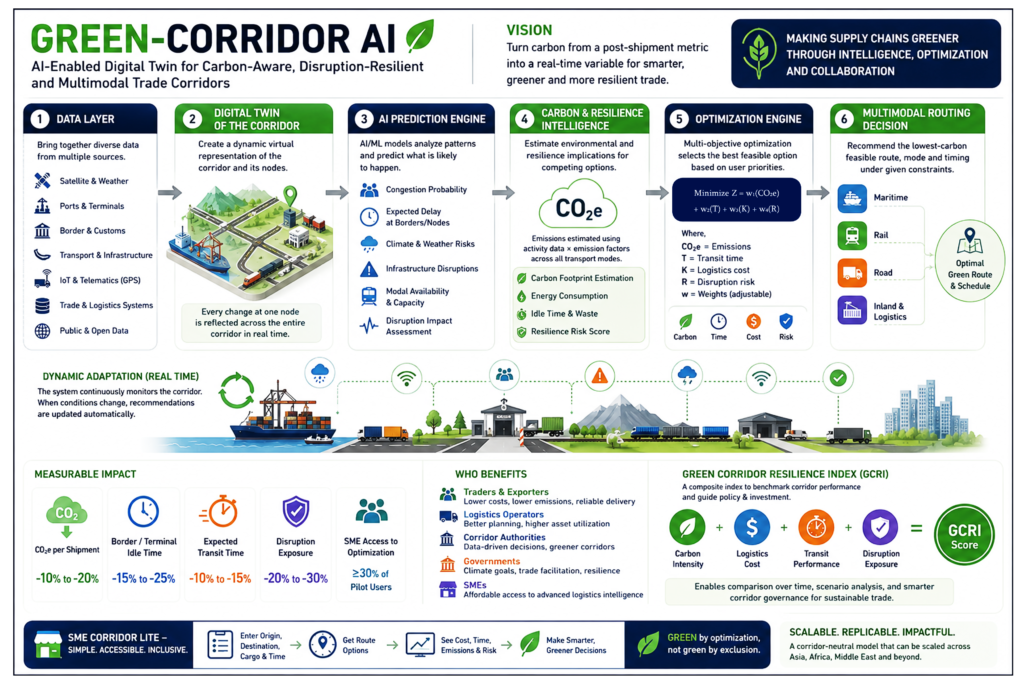
Figure 1. GREEN-CORRIDOR AI: data-to-decision architecture and measurable impact framework
Problem and Opportunity
Modern freight-routing systems commonly optimize cost and delivery time only (Islam et al., 2026). They assess carbon emissions and disruption risk in separate processes. Consequently, these two fragmented processes can produce a route that is economical but risky, fast but carbon-intensive, or green but commercially impracticable. Central point is that the policy gap is not simply a lack of cleaner transport but rather a lack of integrated, cutting-edge corridor intelligence.
Problem is acute in developing-country corridors where infrastructure constraints, border friction, and modal imbalances interact as well (Özcan, 2026). CAREC reports bring to light that more than 95% of Pakistan’s freight moves by road, while rail accounts for about 5%. Average border-crossing time exceeded 33 hours in 2023, with Torkham among the significant bottlenecks (The Corridor Performance Measurement and Monitoring (CPMM), 2023). Delays cause both economic losses and avoidable emissions through idling, detours, and missed multimodal connections.
UNCTAD’s climate-smart trade-facilitation work shows how digitalization can reduce resource use and improve environmental performance (UN Trade and Development (UNCTAD), n.d.). GREEN-CORRIDOR AI extends this logic from measurement and procedure reform to predictive routing. Primary objective is to act on the logistics decision before unnecessary emissions are generated.
Solution Logic
DATA | → | DIGITAL TWIN | → | AI + CARBON | → | OPTIMIZE |
Figure 2. Core data-to-decision flow: the system converts heterogeneous corridor data into a carbon-aware routing decision.
GREEN | Minimize emissions within agreed cost, time and capacity limits. |
BALANCED | Jointly optimize carbon, cost, transit time and disruption risk. |
RESILIENCE | During a disruption, prioritize continuity while retaining the lowest-carbon feasible alternative. |
SME CORRIDOR LITE | Provide simplified route, cost, emissions, time and risk guidance to smaller traders. |
What Is New?
AI is not only source of innovation. The value is obtained by combining four normally distinct functions:
Function | Current practice | GREEN-CORRIDOR AI |
Carbon | Measured/reported after movement | Used before/during routing decisions |
Disruption | Monitored separately | Predicted and linked to route choices |
Modes | Often optimized independently | Compared as multimodal combinations |
Decision | Static/transaction-level | Dynamic corridor-level recommendation |
4. Pilot Design: Pakistan–Central Asia
The pilot focuses on the Pakistan–Central Asia connectivity system within the CAREC Corridor 5/6 framework. It uses a port-to-border-to-Central-Asian trade pathway as the test environment. It does not assume that a fully integrated future rail network is already operational. Instead, digital twin first models the current road-dominated baseline and then tests feasible multimodal scenarios, together with future rail-connectivity assumptions where appropriate. This keeps innovation operationally credible while accommodating infrastructure planning scenarios.
Baseline | AI Test | Comparison |
Road-dominated route; | Alternative route + mode + | CO₂e + cost + transit time + disruption exposure |
5. Data-Science Methodology
The chosen system uses a layered data architecture so that pilot remains practicable even where real-time data are inadequate.
Data layer | Examples | Purpose |
Public | Satellite, weather, transport networks, open trade/port data | Corridor state and environmental context |
Institutional | Customs, border, port, transport authorities | Dwell time, procedures, capacity and bottlenecks |
Operational | GPS, telematics, IoT, logistics-provider data | Near-real-time movement and asset status |
The optimization engine minimizes a weighted objective: Z = w₁(CO₂e) + w₂(T) + w₃(K) + w₄(R), where CO₂e is estimated emissions, T is transit time, K is logistics cost and R is disruption risk. Weights are adjustable by user-defined priorities and operating mode. Emissions are assessed from transport activity data and established emission factors. Additionally, AI models estimate delay and disruption probabilities from historical and current data.
6. Impact and Evaluation
The pilot should demonstrate measured results against a predetermined Business-as-Usual baseline. Following are recommended
validation objectives, not actual test results:
Dimension | Primary KPI | Pilot target* |
Sustainability | CO₂e per shipment / tonne-km | 10–20% reduction |
Efficiency | Border/terminal idle time | 15–25% reduction |
Efficiency | Expected transit time | 10–15% reduction |
Resilience | Exposure to identified disruptions | 20–30% reduction |
Inclusion | SME participation in pilot | ≥30% of pilot users |
* It is pertinent to mention that all targets are illustrative pilot objectives. Actual performance must be established
through baseline measurement and independent validation.
7. Green Corridor Resilience Index (GCRI)
Pilot will also test a composite Green Corridor Resilience Index. This index aggregates four decision dimensions, namely carbon intensity, logistics cost, transit performance and disruption exposure. GCRI is designed primarily to operate as a standardized monitoring and governance tool for corridor authorities. It will also make it possible to track over time and compare scenarios. Furthermore, it can help prepare plans for climate adaptation, trade facilitation reforms,
and decision-making on infrastructure priorities.
8. Feasibility, Governance and Scale
Phase / actor | Action |
0–6 months | Baseline, corridor mapping, data inventory and emissions methodology. |
6–12 months | Digital-twin prototype and historical-data integration. |
12–18 months | AI disruption forecasting and multimodal optimization tests. |
18–24 months | Operational demonstration with selected corridor stakeholders. |
Governance | Public authorities + logistics firms + technology providers + development partners + independent researchers. |
Scale | Replicate the corridor-neutral architecture across CAREC, African, ASEAN and other intercontinental corridors. |
Platform being used will adopt explainable AI, role-based user access, cross-platform compatibility standards, data minimization, and privacy protection. Rather than generating opaque route options, standard recommendations will reveal main reasons, which could include anticipated congestion, emissions, and disruption probability. This framework will build international trust and guarantee safety of sensitive business data.
9. Competitive Advantage and Risk Management
GREEN-CORRIDOR AI is intended as a decision-support layer rather than a new physical logistics network. It is useful in lowering entry barriers. For example, pilot can start with existing routes, publicly available information and some degree of institutional data, and then, at the next stage, add live operational feeds as partnerships are established. Another benefit is that this approach does not assume that any particular mode of transport is inherently green. Rather, it chooses most practical arrangement given real cargo, maximum capacity, and corridor conditions that exist. This is absolutely essential because a potentially lower-carbon mode could prove impracticable if it causes excessive delays, lacks sufficient capacity, or raises overall logistics costs.
Three risks associated with implementation will be addressed from very beginning. First, explicit confidence scores and a progressively standardized data architecture will be the methods implemented to deal with incomplete data. Second, robust independent validation, human oversight for high-stakes decisions, and historical back-testing methods will be employed to address bias within model or erroneous predictions about future. Third, role-driven access control, standardized anonymization, and explicit data exchange protocols shall be applied when dealing with commercial and cross-border sensitive data. These safety measures build trust in the system for both private logistical use and public sector uptake.
10. Policy Value and Replication
GREEN-CORRIDOR AI may produce corridor-level insights for governing bodies and development entities in conjunction with freight-level routing. Repeated simulations may identify areas where specialized modular capital investments, border reforms, or smaller structural upgrades would lead to the biggest overall improvements in emissions, time, and resilience. This effectively converts standard operational information into policy intelligence. Proposed Green Corridor Resilience Index might provide a common language for comparing corridors and keep track of whether investments actually contribute to green trade performance.
Prototype is built for replication using standard techniques. Once data schema, optimization logic and evaluation framework are established, same architecture can be configured for another corridor without rebuilding concept from scratch. It has potential applications, such as establishing connectivity among African port-to-landlocked-state corridors, ASEAN multimodal routes and Middle East–Asia trade links. This potential for scaling supports achievement of a broader trade and development objective, which aims to enable developing economies to engage in world trade with greater efficiency and sustainability while increasing their resilience to future economic shocks.
11. Expected Contribution
Eco-friendly trade, supply-chain resilience, and developing-country competitiveness are three desired goals that are often interpreted as separate from one another but GREEN-CORRIDOR AI provides a workable solution that brings them together. The approach is easy to understand rather than requiring all traders to become green experts or every corridor to first construct new conventional physical infrastructure, higher-quality prediction and optimization can help reduce needless emissions.
GREEN-CORRIDOR AI: Make the greener trade decision the smarter trade decision. |
12. Selected References
Islam, T., Abdullah, J., Munna, M. M. H., Hasan Nahid, N. A. A., Tusar, M. I. H., & Sarder, M. (2026). Multi-objective optimization for transportation mode selection: A case study in logistics. The Asian Journal of Shipping and Logistics, 42(2), 109–116. https://doi.org/10.1016/j.ajsl.2026.01.002
Özcan, İ. Ç. (2026). Significant barriers to transport corridor development in Islamic countries: A multinational assessment. Research in Transportation Economics, 117, 101769. https://doi.org/10.1016/j.retrec.2026.101769
The Corridor Performance Measurement and Monitoring (CPMM). (2023). 2023 Report. https://cpmm.carecprogram.org/2023-report/pakistan/
UN Trade and Development (UNCTAD). (n.d.). Climate-smart trade facilitation. Retrieved August 25, 2026, from https://unctad.org/topic/transport-and-trade-logistics/trade-facilitation/climate-smart-trade-facilitation



What Pakistan Can Learn from Poland’s Energy Transition