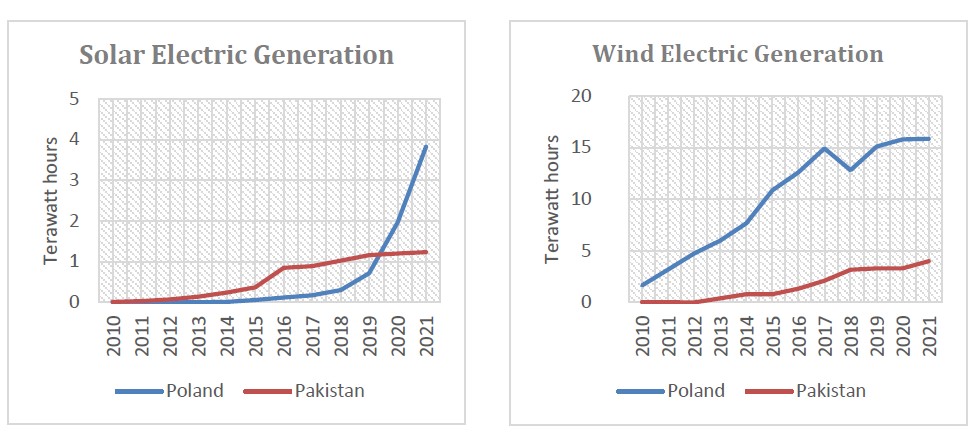
The fact is that Poland has spent many years defending its coal industry and is now one of Europe’s fastest-growing markets for solar power. Similarly, Pakistan has a golden opportunity to accelerate its progress beyond the rate it is currently achieving. For a long time, Poland was regarded as the nation that had been hindering Europe’s climate ambitions; this image has remained with it ever since coal played such a major role in both its economy and politics. However, this view is to some extent out of date. From 2010 to 2021, for example, the share of renewable electricity in Poland rose from 6.9% to 16.9%. Over the past five years, its solar capacity has reached 7.7 gigawatts by 2022, and according to the most recent entry in the IEA’s project database, it has now reached 13.8 gigawatts. This achievement has made Europe the fastest-growing solar market in Europe. Furthermore, the country has met its 2020 target of 15% renewable energy and placed fifth in the EU for the number of installed solar panels. So far, offshore wind agreements have covered 5.9 GW, with a target to generate 27% of its total power from wind by 2050. It is worth noting that Poland did not achieve this position because it was wealthy; instead, it did so gradually, in effect treating the transition as a smooth negotiation rather than a sudden change.
Pakistan’s Energy Stats
When it comes to Pakistan, renewable energy has hitherto accounted for about 33.1 per cent (2025) of its electricity production. The combined capacity of solar and wind power is roughly 17514 megawatts, which is about 13.2 per cent of the total capacity and around 5 per cent of the actual power generated. The most alarming aspect is the increase in oil imports, which rose from $14.6 billion in 2017–18 to $17 billion in 2019–20 and amounted to $16.86 billion in FY2025–26. Electricity consumption increased by 19 per cent in 2018 and is expected to go up by another 28 per cent by 2040; even though there is a rapid rise in energy demand, the problem is not a lack of resources. In this context, a study carried out by the National Renewable Energy Lab in collaboration with USAID is reported to have estimated Pakistan’s solar and thermal potential at as high as 2,900,000 MW. Notably, the World Bank has found that in order to meet all of Pakistan’s current electricity consumption it would be sufficient to use just 0.071 per cent of the country’s land area for solar photovoltaic purposes. As for wind energy, wind speeds in the best areas average 7.87 m/s and wind energy potential therefore exists in Pakistan. A study published in the Pakistan Languages and Humanities Review in 2024, entitled “Green Energy Cooperation between Pakistan and Poland: Prospects and Challenges for Sustainable Development”, authored by Dr. Muhammad Amjad Raza and others, looked at the gap in its entirety by comparing Pakistan’s green energy transition with that of Poland.
What Poland Did?
The following four points are notable in Poland’ s energy sector and are examined in turn. Poland did not stop using coal all at once; instead, it first drew up an all- embracing strategy for renewable energy and then put it into practice. Coal usage was reduced step by step while the alternative energy sources were being expanded. As a result, the national energy policy approved by the government in February 2021 also established a clear sequence, namely: reduce the use of coal for electricity and heating first, promote the development of renewable energy at the same time, and then move on to offshore wind. In this way, the use of market mechanisms was very effective. Subsequently, when carrying out its green energy strategy, Poland introduced green certificates, renewable energy auctions and various support schemes, among other measures, in order to create a clear price signal. All the decisions were made by the state in a highly transparent manner, taking into account the views of all the relevant stakeholders; in practice, investors did not have to speculate about what the government would do next. It is worth noting that Poland regarded the transition as part of its industrial policy. The country has set aside about €195 billion to modernise its energy sector in order to meet the targets set out in the National Energy and Climate Plan from 2021 to 2030. In sum this is not solely aimed at improving air quality; supply chains, employment opportunities and export potential were also included in the fiscal strategy. The key aspect of Poland’ s green policy is that it made use of diplomacy as an effective tool. Poland has played a commendable role in this regard by campaigning for Pakistan to be included in the EU’ s GSP + scheme, thus helping to eliminate duties on more than 66% of the EU’ s tariff lines. As a result, Pakistan’ s exports to Europe increased sharply by 50% and reached €6.7 billion between 2013 to 2019, and amounted to $ 9. 089 billion in the financial year 2026.
The Justifiable Dilemma
Poland enjoys membership of the EU as well as adequate financial support from it. Pakistan’s situation is entirely different since it does not have such funding. This difference has a major impact and is important. However, the mechanisms which led to Poland’s transition—such as auctions, certificates, staged targets, and a federal policy anchor—were not come up with by Brussels. This is the key issue that Pakistan must urgently address and should realise that such options are available to any government. In Poland’s case, the EU had only provided the financing and a deadline; it did not offer the sequence, the support or the guidance. Moreover, Pakistan also has its own advantages, namely a market of 240 million people, investment through CPEC, and access to Europe under the GSP+ arrangement. Furthermore, Poland is a partner with which Pakistan has strong ties dating back to 1962 and whose trade has been over €500 million by 2018, increasing to €820.36 million ($920 million) by 2025.
Where the Opportunity Sits
Looking at the trade figures between the two countries, it is clear that one point emerges: Pakistan and Poland trade in almost everything except for energy, the sector which is most overlooked in their trade relationship. The cooperation between them in the field of green energy is still untapped. It is certainly true that this situation is less a failure than an opportunity. Pakistan already possesses institutions such as the AEDB, the PCRET and NEPRA, together with a competitive trading model that is currently being developed. The State Bank has also produced green banking guidelines. The country has set a target of 60% renewable capacity by 2030 in order to promote green energy. To sum up, what is needed at this stage? The answer lies in a clearer sequence and a partner who is ready to move from trading goods to sharing technology.
Five Areas Worth Focusing On:
It is important to concentrate on a few areas rather than many—specifically, solar PV and wind as indicated in the previous research. The study points out that a focused approach tends to progress more quickly than a diffuse one and recommends that policy should remain at the federal level. It explains that a single national strategy is simpler for investors to grasp than having several regional ones and also suggests that states should use auctions and green certificates together with subsidies. It advises that market-based mechanisms are more sustainable than reliance on fiscal support alone. Nevertheless, all financing concerned must comply with international standards and that foreign investment will go to places where legal risk is clear and insured. Although Pakistan has a green finance framework in place, the next move should be to make it fully operational and consolidated. It is necessary to turn the relationship with Poland into a technology partnership. In light of this, the next step should be to reach a concrete agreement on solar, wind, and smart grid integration, including timelines on both sides, one that goes beyond a memorandum of understanding and zeroes in on practical solutions.
The Lesson for Pakistan
The fact that Poland’s experience is not merely about moving away from coal should be clear—it’s a story of a nation that has rewritten its own destiny and transformed itself from being one of Europe’s slower states into one of its most dynamic ones. This change happened gradually, taking ten years and involving a number of deliberate decisions as part of the process. Given these circumstances, Pakistan has the sun, the wind, and a partner (Poland) which has already carried out the difficult work. At the moment, Pakistan needs a much more definite sequence of steps; there can be no dispute about this, for it is a policy decision and entirely within reach.
Commentary has been written regarding the research paper entitled “Green Energy Cooperation between Pakistan and Poland: Prospects and Challenges for Sustainable Development”. https://doi.org/10.47205/plhr.2024(8-IV)46